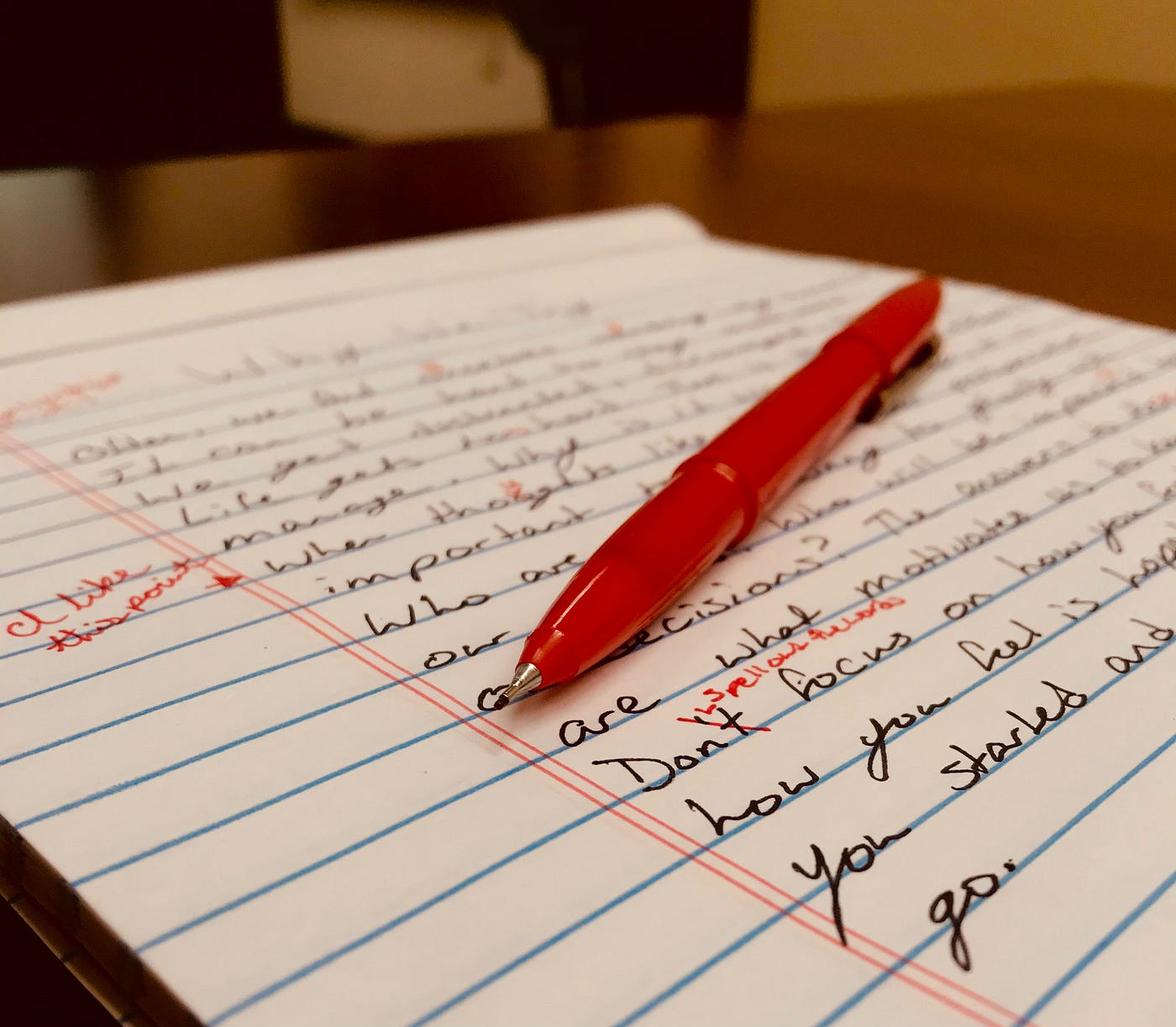
I don’t remember what exactly pushed me into the idea of spending an entire day writing only with red ink. Maybe it was the boredom of a slow morning, or the odd satisfaction of finding an old red pen buried under a stack of receipts. Or maybe it was just one of those impulses that arrive uninvited, like a gust of wind that flips your hair into your mouth before you’ve even had your coffee. Whatever the reason, I picked up that red pen, uncapped it, and decided—without ceremony—that every word I wrote that day would be red.
The first thing I noticed was how loud the ink looked on paper. It wasn’t the quiet, soft-spoken blue I usually default to, nor the tidy, obedient black that behaves in a straightforward, no-nonsense way. Red barged into the page like a person who slams the door not out of anger but because they simply never learned how to close it gently. My handwriting looked different in red, too—sharper, more energetic, almost mischievous. It reminded me of being in school and feeling like a rule-breaker for using a pen color teachers didn’t approve of.
I started with my grocery list, which suddenly looked like some kind of urgent message. Tomatoes, yogurt, paper towels—each item felt like a small alarm. Even “dish soap” looked dramatic, as if I were preparing to wash dishes in a crisis scenario. There’s something about red ink that makes everything seem more important than it actually is. Ordinary words become declarations.
When I moved on to journaling, the effect grew stranger. My thoughts looked louder than they felt. A simple line about being tired looked almost theatrical in crimson. Writing about a small annoyance felt like I was scolding the page. Even casual observations—like how my neighbor’s dog barked at absolutely nothing for fifteen minutes—took on the energy of a formal complaint. Red doesn’t let you be neutral. It insists on intensity.
At first, I tried to soften my handwriting, make the letters rounder, friendlier, as if that would calm the ink down. It didn’t. The red took over the mood, painting everything with a sort of emotional saturation. But after a while, I stopped trying to fight it. Instead, I let the red ink shape the way I wrote and even the way I thought.
By lunchtime I’d stopped noticing how dramatic my notes looked and started noticing how aware I felt of each word I wrote. There’s something grounding about choosing to write in a way that feels slightly unnatural. My hand slowed down, not because the pen required it, but because the color made everything feel deliberate. A to-do list became a sequence of decisions rather than obligations. A reminder to take out the trash suddenly felt like a message from a more assertive version of myself.
At some point in the afternoon, I wrote a short letter I’d been delaying for weeks. Nothing dramatic—just a note to a friend I hadn’t replied to. But the red ink made me more honest than usual. Not brutally honest, just more direct. It was like the color nudged me toward clarity, as if it refused to let me hide anything behind polite phrases. When I finished, the letter looked like something written by someone braver than me, or at least someone who doesn’t second-guess every sentence.
Even my doodles were transformed. I scribbled a few shapes in the margins of my notebook—circles, squiggles, the kind of random drawings you do when your brain goes on walkabout—and they looked strangely alive. Red gives even nonsense energy. A doodle isn’t just a doodle; it’s a moment of expression. I couldn’t believe I had spent years ignoring red pens like they were some kind of forbidden fruit of stationery.
The most surprising part of the day came in the evening. I sat down to review some notes I’d made earlier—just a few thoughts about an idea that had been floating around for days—and when I reread them, they felt completely different. The color made my own ideas feel unfamiliar, as if someone else had written them. It was oddly refreshing. It felt like looking at my daily routine through a lens I didn’t usually use.
It reminded me of the way a room looks different at night than during the day. Same furniture, same walls, but everything shifts under a new kind of light. Red ink did that for my thoughts. It shined a different kind of lamp on them, making shadows where I didn’t expect them and highlighting corners I’d overlooked.
There’s also something a little rebellious about writing in red. I’m not sure where the association comes from—maybe old memories of teachers marking mistakes, or warnings printed on packaging, or those urgent letters that tell you a bill is overdue. Red is the color of being noticed. So spending a whole day writing with it felt like letting myself take up more space on the page than I do usually. It wasn’t about drama; it was about permission.
Later that night, when I finally capped the pen and set it aside, I realized the day had left me with a very particular feeling—like I’d had a conversation with myself in a slightly different tone than my usual one. Not louder, not angry, not excited. Just more awake. Red ink doesn’t let you drift through words half-asleep. It demands that you be present, even when you’re only jotting down a reminder to buy almond milk.
The next morning, I went back to my usual black pen without thinking. The page felt calmer, quieter, almost too quiet. For a moment, I missed the boldness of the red. I missed the way it made even the most trivial sentence feel like it mattered. I didn’t switch back immediately—I wasn’t ready to give up the small spark of intensity that red ink had added to the day. But I kept the red pen nearby, like someone keeping a bright sweater in the closet for days when the weather feels too dull.
I didn’t expect a single color to shift the way I experience writing, or the way I move through my routine. But spending a day writing only with red ink was like tuning into a slightly different frequency of myself. Not better, not worse—just sharper, more intentional, more vivid.
And maybe that’s the whole point of these small, strange experiments we do with our everyday habits. Sometimes all it takes is a single bold line of color to remind you that your ordinary day still has room to surprise you.